 Day Trips from Jerusalem
Is It Safe to Visit Bethlehem? An Honest Look at the Advice
Is it safe to visit Bethlehem? The UK Foreign, Commonwealth and Development Office does not advise against travel to Bethlehem Governorate, even though it does advise against all travel to some other parts of the West Bank. That is a factual statement about official advice, not a personal guarantee, and the advice changes. Bethlehem is a Palestinian city in the West Bank, administered by the Palestinian Authority, and foreign tourists cross into it through Checkpoint 300 with a passport. The practical questions sit alongside the headline question. Which areas does the advice actually cover? What happens at the checkpoint? Who cannot cross at all, and which vehicle cannot make the trip? And is the visit easier with a licensed local guide than on your own by bus? This guide works through what the official advice says, what the rules on the ground are, and how the guided options among the day trips from Jerusalem compare with going independently, so you can weigh the decision with the documents in front of you.
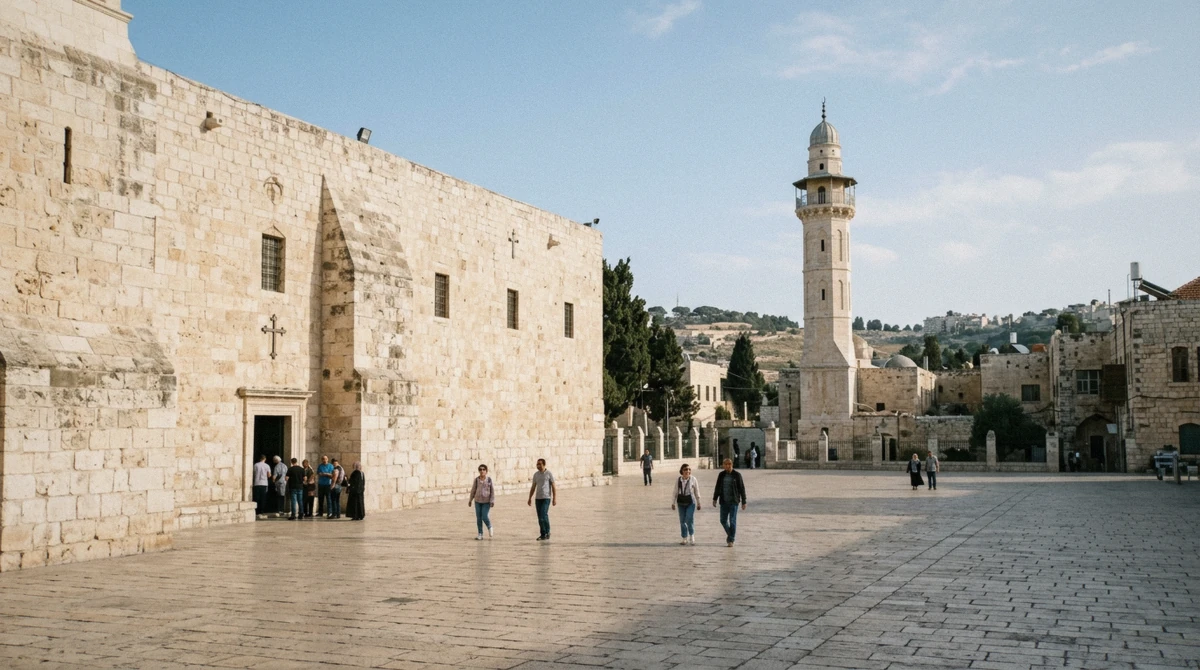
Illustrative image of Manger Square on a calm morning.
Quick answer FCDO does not advise against Bethlehem Governorate. Crossing rules, passport and dress notes explained.
The UK FCDO advises against all travel to Tulkarm, Jenin and Tubas in the West Bank, and against all but essential travel to the rest of the West Bank, with named exceptions. Those exceptions include Bethlehem Governorate, Ramallah Municipality, Jericho Municipality, East Jerusalem and everything south of Jericho. So Bethlehem sits outside the areas the FCDO advises against, and the US State Department publishes its own advisory separately. Tourists cross at Checkpoint 300 with a passport and are checked again on the way back into Jerusalem. Israeli citizens cannot use that crossing, and Israeli taxis and rental cars cannot enter Bethlehem. The advice changes, so read the current FCDO page before you book and again before you travel.
Key takeaways
- The UK FCDO names Bethlehem Governorate, Ramallah Municipality and Jericho Municipality as outside the West Bank areas it advises against, but travel against FCDO advice can invalidate travel insurance.
- Every guided Bethlehem crossing needs a passport, and one listing also asks for a valid Israeli visa. See how the Half-Day Bethlehem Guided Tour from Jerusalem handles documents and timing.
- Israeli citizens cannot cross at Checkpoint 300, and Israeli taxis and cars rented in Israel cannot enter Bethlehem.
- Buses 231 and 234 run from near Damascus Gate, and you walk through the checkpoint yourself. The route is set out in Jerusalem to Bethlehem.
- For a wider day out, the Bethlehem, Jericho and Jordan River Day Tour from Jerusalem combines the city with the desert and the baptism site.
Should you go, and how
If you want the shortest, best rated visit with a licensed local guide
The Half-Day Bethlehem Guided Tour from Jerusalem runs four hours and returns to the David Citadel Hotel.
If you want to see more of the West Bank in one day
The Bethlehem, Jericho and Jordan River Day Tour from Jerusalem adds Jericho and the baptism site, or the Best of the West Bank Tour from Jerusalem: Ramallah, Jericho and Bethlehem adds Ramallah and Aida refugee camp.
If you prefer to travel independently
Buses 231 and 234 leave from Sultan Suleiman Street near Damascus Gate. Check the timetable the day before, since it changes.
If you hold an Israeli passport
You cannot join the guided Bethlehem trips in the catalog, and you cannot cross at Checkpoint 300.
If your government's current advice covers the area you plan to visit
Read the FCDO advice for the occupied Palestinian territories before booking and again before travelling, because travelling against it can invalidate insurance.
What the UK FCDO actually says about the West Bank
The UK Foreign, Commonwealth and Development Office publishes country advice for the occupied Palestinian territories. For the West Bank it draws a clear map. It advises against all travel to the governorates of Tulkarm, Jenin and Tubas, with the exception of Route 90 which runs through them.
For the rest of the West Bank it advises against all but essential travel, with a list of named exceptions. Bethlehem Governorate is one of those exceptions, alongside East Jerusalem, Ramallah Municipality, Jericho Municipality and all areas south of Jericho, which includes the Allenby crossing. In plain terms, Bethlehem, Ramallah, Jericho and the Allenby crossing sit outside the areas the FCDO advises against.
Two things follow from that. First, the FCDO also warns that the regional situation is unpredictable and that travel insurance can be invalidated by travelling against its advice, so the exceptions do not cancel the caution. Second, the advice changes.
Read the current page before you book and again before you travel. The US State Department publishes its own advisory for Israel, the West Bank and Gaza separately at travel.state.gov, so check the one that applies to your passport.
The table below sets the areas against the FCDO position, so you can see at a glance which places are named and which are not. It comes straight from the FCDO advice for the occupied Palestinian territories.
| Area | What the FCDO says |
|---|---|
| Gaza, and land within 500 m of the Gaza border | Advises against all travel |
| Tulkarm, Jenin and Tubas governorates | Advises against all travel, except Route 90 |
| The rest of the West Bank | Advises against all but essential travel |
| Bethlehem Governorate | Named as an exception, so outside the areas advised against |
| East Jerusalem, Ramallah Municipality, Jericho Municipality and areas south of Jericho, including the Allenby crossing | Named as exceptions, so outside the areas advised against |
Note what the table does not say. It is not a claim that any area is risk-free, and it is not a substitute for the current page. The FCDO itself stresses that the situation is unpredictable.
Treat the exceptions as the official starting point for a decision, not the end of it.
The different kinds of safety, separated
Crossing and documents
The main practical issue for a Jerusalem day trip is the checkpoint, not the street. Bring your passport, expect a security check on the way in and again on the way back into Jerusalem, and keep the passport handy for the return. The listings describe these checks as routine.
Getting around
Israeli taxis and cars rented in Israel cannot cross into Bethlehem, so the choice is a guided vehicle that changes at the city line, a Palestinian taxi after the checkpoint, or your own feet. The bus stops on the Jerusalem side of the checkpoint, so everyone walks through.
Sites and crowds
Entry to the birth grotto in the Church of the Nativity depends on crowd levels, and the listings advise avoiding Sunday mornings and major Christian holidays. That is a comfort issue rather than a safety one, but it shapes the day.
Health
Bethlehem sits in the hills south of Jerusalem, so sun, long trousers and comfortable shoes are the practical asks on every listing. Medication or health questions are a travel-clinic conversation, not something a guide page can settle.
The wider region
The areas the FCDO advises against all travel to are elsewhere in the northern West Bank, around Tulkarm, Jenin and Tubas, and Gaza. None of the day trips compared here go there.
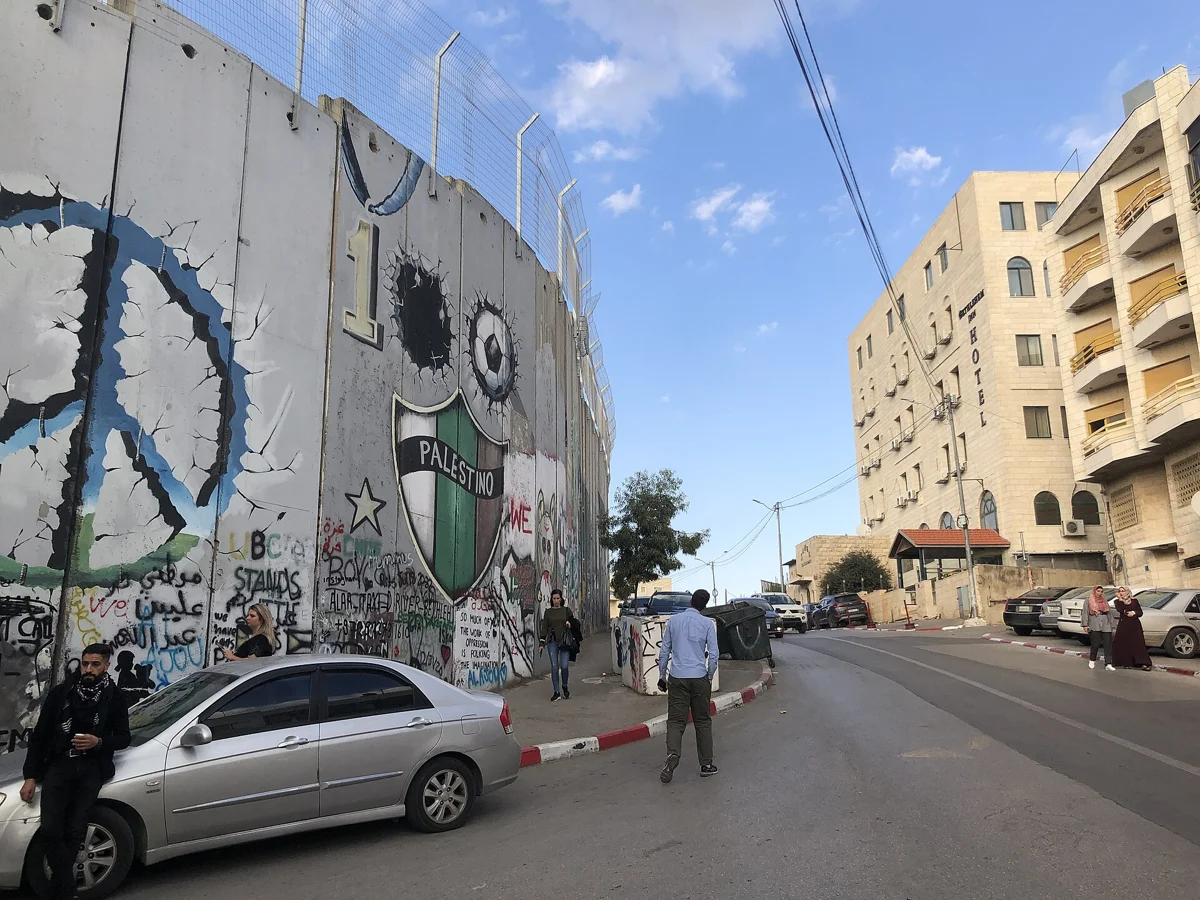
Graffiti on the separation wall in Bethlehem. Photo: Davide Mauro, CC BY-SA 4.0, via Wikimedia Commons.
Checkpoint 300 and your passport
Checkpoint 300 is the main crossing for tourists between Jerusalem and Bethlehem. The bus stops on the Jerusalem side, you walk through the checkpoint with your passport, and then you walk about 2 km to Manger Square or take a Palestinian taxi. Coming back, you show your passport again to re-enter Jerusalem.
The listings describe the security checks, entering or leaving Bethlehem, as routine.
The passport matters on the guided trips too. Every catalog tour that enters Bethlehem or the other Palestinian cities asks for one, and the Half-Day Bethlehem Guided Tour from Jerusalem also asks for a valid Israeli visa. For anything crossing into Palestinian-administered areas, carry the original.
- Bring your original passport on any Bethlehem or West Bank trip
- One listing additionally requires a valid Israeli visa
- Expect security checks entering and leaving Bethlehem, described as routine in the listings
- Israeli citizens cannot cross at Checkpoint 300
- Israeli taxis and cars rented in Israel cannot cross into Bethlehem
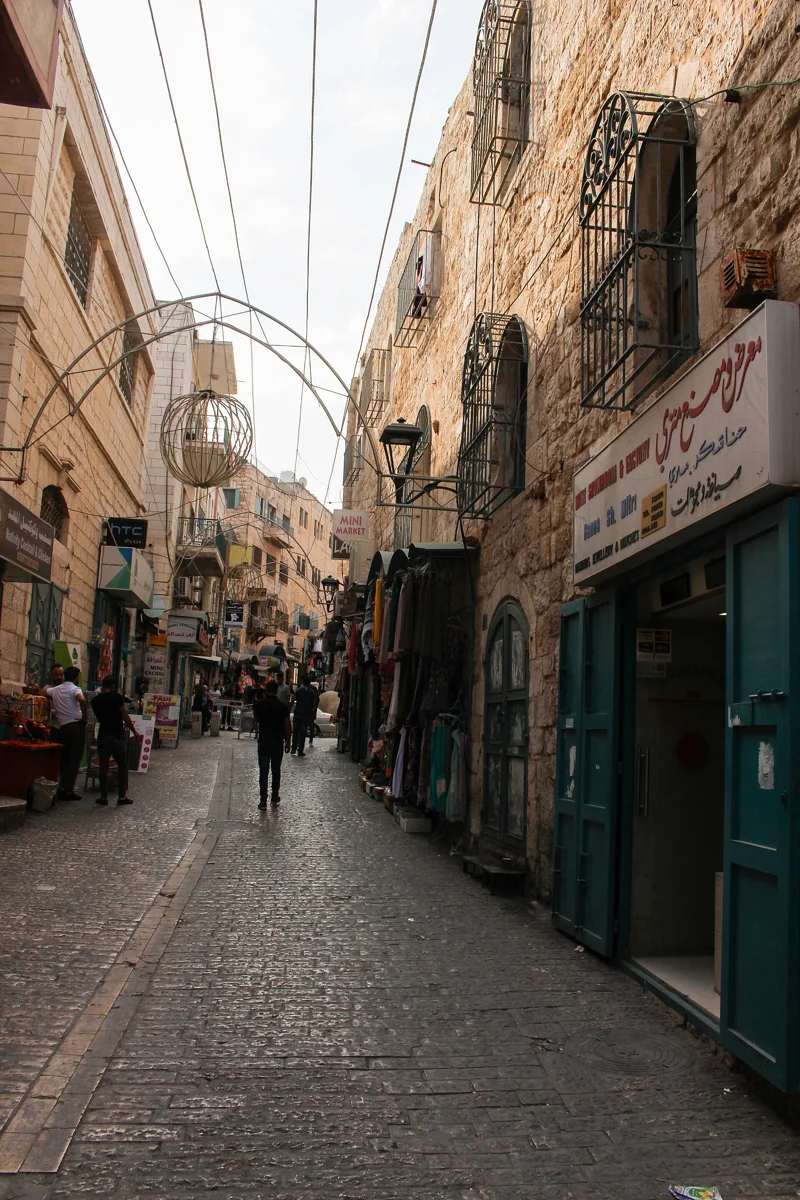
A lane in the old market of Bethlehem. Photo: Bashar Nayfeh, CC BY-SA 4.0, via Wikimedia Commons.
Who cannot make the trip
The rules cut both ways, and the listings state them plainly. Every catalog tour that enters Bethlehem, Jericho or Ramallah says Israeli passport holders cannot join. That is a listing condition, not a judgement, and it mirrors the rule at the checkpoint itself, where Israeli citizens cannot cross at Checkpoint 300.
Vehicles face their own rule. Cars rented in Israel and Israeli taxis cannot cross into Bethlehem, which is why the guided trips change vehicle at the city line. On the Bethlehem, Jericho and Jordan River Day Tour from Jerusalem, a licensed local Palestinian Christian guide takes over in Bethlehem, which is where the vehicle change happens.
Going independently, the practical consequence is that you either walk the roughly 2 km from the checkpoint to Manger Square or take a Palestinian taxi on the Bethlehem side.
Mobility is a separate limit worth naming. The half-day Bethlehem trip and the Bethlehem, Jericho and Jordan River day are both listed as not suitable for wheelchair users or people with mobility impairments.
With a licensed guide or alone by bus
Both routes are real options, and neither changes the checkpoint rules. The differences are in price, guiding, time and what is included. The figures below come from the tour listings and the independent transport notes, so you can weigh them side by side.
| Detail | Guided day trip from Jerusalem | On your own by bus |
|---|---|---|
| Route | Vehicle from central Jerusalem through the checkpoint | Bus 231 or 234 from Sultan Suleiman Street near Damascus Gate, then walk through Checkpoint 300 |
| Time | 4 hours for the half day, 10 hours for the combined days | About 30 minutes on bus 234 to the checkpoint, then about 2 km on foot to Manger Square or a Palestinian taxi |
| Price | $75 for the half day, $150 for the Jericho and Jordan River day, $156 for the Ramallah, Jericho and Bethlehem day | Bus fare not stated |
| Guiding | Licensed local guide in Bethlehem on all three | None, you navigate the sites yourself |
| Documents | Original passport, one listing also a valid Israeli visa | Passport, shown again on the way back into Jerusalem |
| Flexibility | Fixed itinerary and start time shown at checkout | You set the pace, but check the timetable the day before |
If you take the independent route, remember that the bus drops you on the Jerusalem side of the checkpoint, so the walk and the Palestinian taxi are part of the plan. Timetables change, so check the day before you travel. If you would rather let someone else handle the crossing, the Jerusalem day trips comparison sets all the guided options and their prices side by side.
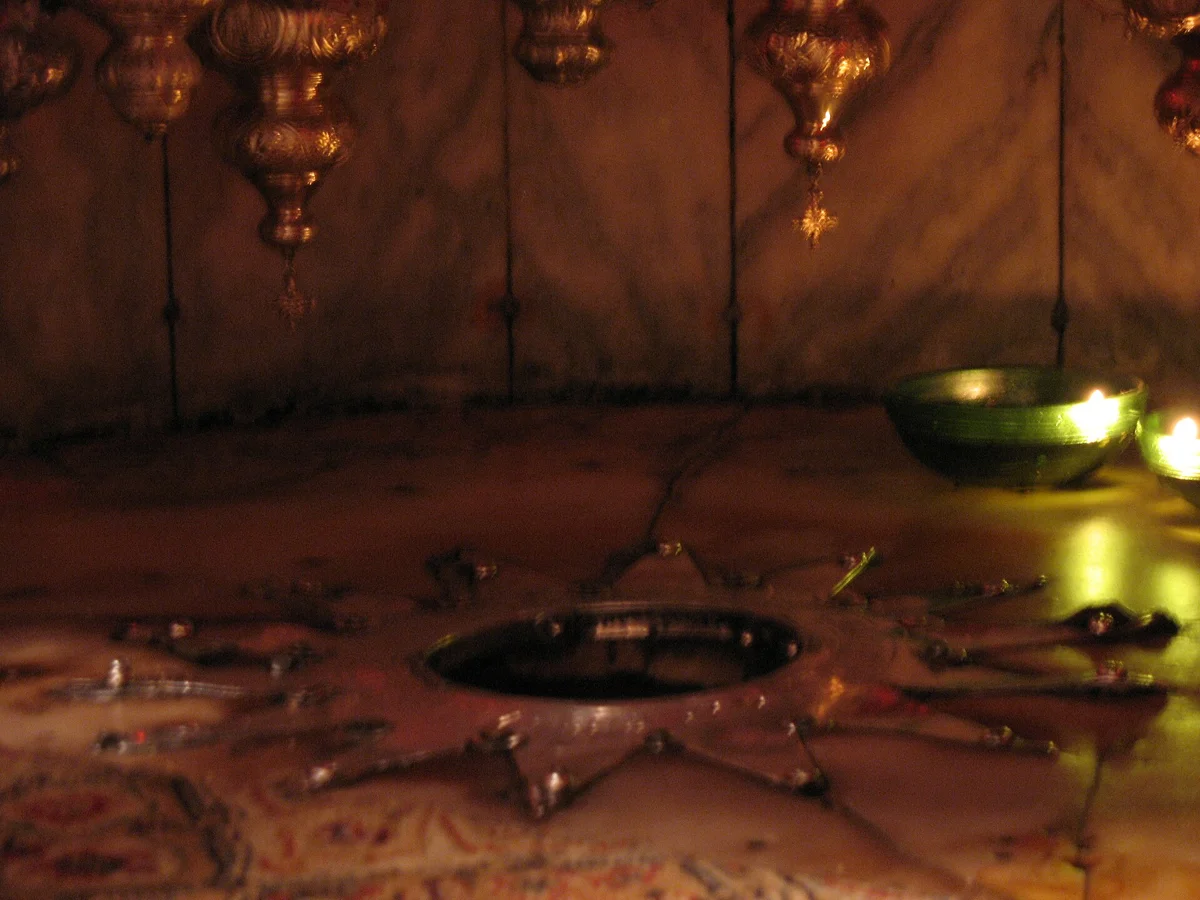
The star that marks the traditional birthplace in the Grotto of the Nativity. Photo: James Emery from Douglasville, United States, CC BY 2.0, via Wikimedia Commons.
Dress, churches and what to carry
Modest dress is a listed requirement, not a suggestion. The half-day Bethlehem trip says no shorts, short skirts or sleeveless tops in the churches, and asks for long trousers, comfortable shoes and a sun hat. The Ramallah, Jericho and Bethlehem day repeats the rule and adds a scarf or shawl to carry, since the day covers active places of worship in more than one city.
What to carry follows from the day. The passport original goes on every West Bank trip. Cash is worth having on the Jericho day, where Hisham's Palace and Old Jericho each cost $3.23 (10 NIS) on the day.
Water is simple, since the Bethlehem trips hand out one bottle per person, but food is not included on any of them.
The Church of the Nativity itself is the reason most people come. It was first built around 330-333 after Constantine's mother Helena visited, rebuilt by Justinian in the 6th century, and is the oldest major church in the Holy Land. The compound covers about 12,000 square metres with Catholic, Armenian and Greek Orthodox monasteries.
Modest dress and some walking and standing are the practical asks.
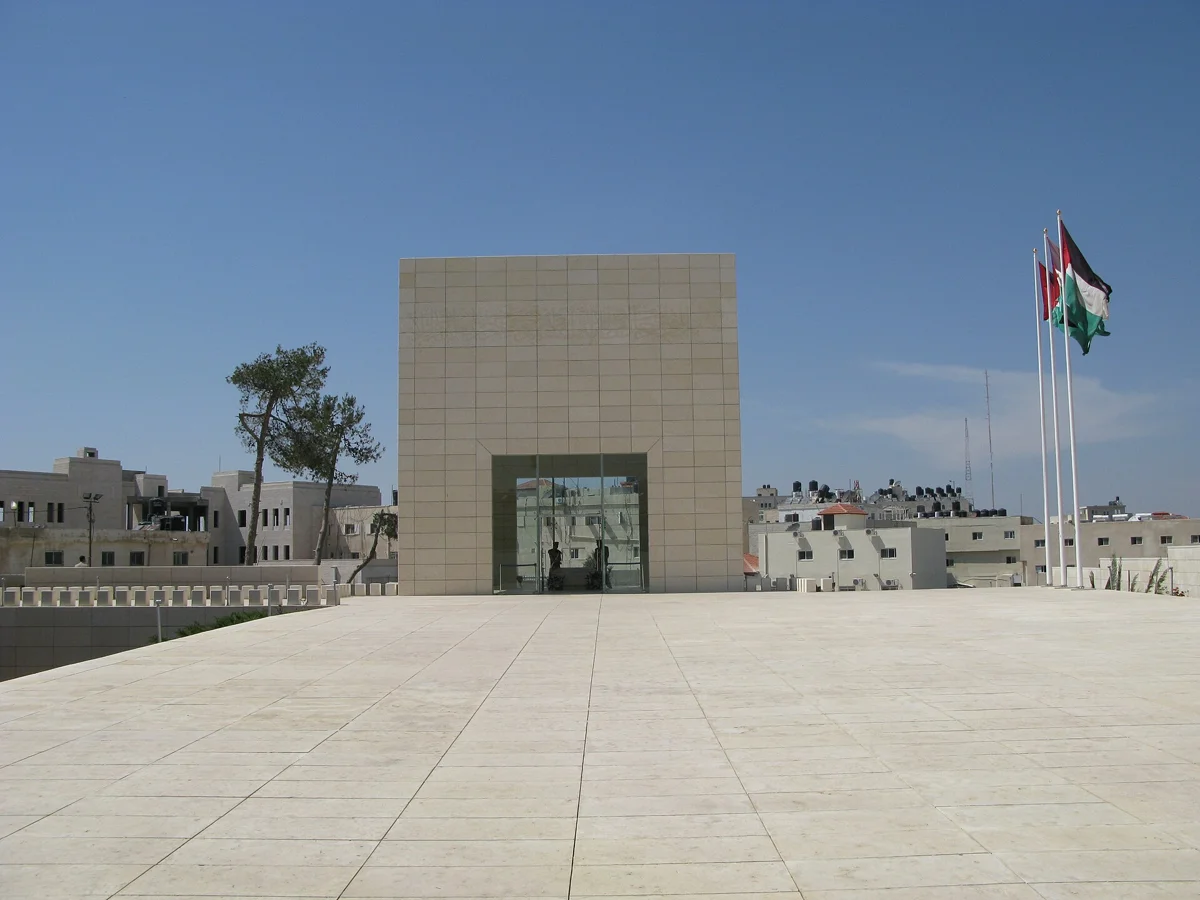
The mausoleum of Yasser Arafat in Ramallah. Photo: Tristam Sparks, restlesseye.com, CC BY-SA 3.0, via Wikimedia Commons.
Crowds, Christmas and Sunday mornings
The listings are specific about timing. Entry to the birth grotto depends on crowd levels, and the half-day listing advises avoiding Sunday mornings and major Christian holidays.
The practical response is to book a weekday if you can and to treat Sunday mornings as the slot to avoid. On the half-day trip you get about an hour at the Church of the Nativity and 30 minutes at Shepherds' Field in Beit Sahour, which the Gospel places as the scene of the angels' announcement. On the combined West Bank day, Bethlehem gets a full three hours, which spreads the pressure across more of the site.
None of this is a safety warning. It is crowd management, and the operators name it because it affects whether you get down into the grotto at all. If seeing the grotto matters to you, the timing advice matters more than the choice of trip.
Emergency numbers, medical care and insurance
Save the emergency contacts from your own government's travel page before you go, and ask your guide or hotel on arrival. The FCDO page for the occupied Palestinian territories carries its current contact details.
Insurance deserves a specific look. The FCDO warns that travel insurance can be invalidated by travelling against its advice, which is one more reason to confirm that Bethlehem Governorate remains outside the advised-against areas on the day you travel. Listings on the Dead Sea trips also name insurance as not included, so check what your own policy covers before booking any of these days.
Can children visit, and what about seniors
Can children visit safely?
Yes, on the right trip. The half-day Bethlehem listing sets no minimum age, and the Bethlehem, Jericho and Jordan River day asks simply that children come with an adult. The Ramallah, Jericho and Bethlehem day takes all ages and provides infant seats.
The main physical ask is walking and standing at the churches, so a full-day itinerary with three cities suits some families better than others.
Is it safe for seniors?
The honest asks are physical rather than anything else. The half day runs four hours with some walking and standing, and about an hour at the Church of the Nativity, which is the most demanding block. Both Bethlehem day trips are listed as not suitable for wheelchair users or people with mobility impairments, so if standing for an hour is a problem, the shorter half day is the better fit than a ten-hour combined day.
Booking smart
The safety decision, so far as it is yours to make, comes down to three things. Read your own government's current advice, including the US State Department advisory if that is the one that applies to you, and confirm Bethlehem is still in the exception list. Carry the passport original.
And pick the format that matches your comfort level, a licensed local guide who handles the crossing and the vehicle change, or the independent bus route where you manage the checkpoint walk yourself.
Among the guided options, the Half-Day Bethlehem Guided Tour from Jerusalem is the shortest and best rated at 4.8 from 619 reviews. The Best of the West Bank Tour from Jerusalem: Ramallah, Jericho and Bethlehem runs with a small group of up to 20 and is the only one that goes into Ramallah, though if access to Ramallah is restricted the day adds time in Jericho and Bethlehem instead. Both follow the same rules set out above, a passport, modest dress and a licensed guide inside the city.
Bethlehem Governorate sits outside the areas the UK FCDO advises against, the crossing rules are published, and the choice between guide and bus is a practical one rather than a safety one. Check the current advice, carry your passport, and pick the format that suits your day.
Questions and Answers
Is it safe to visit Bethlehem right now?
The UK FCDO does not include Bethlehem Governorate in the West Bank areas it advises against, though it advises against all travel to Tulkarm, Jenin and Tubas and against all but essential travel to the rest of the West Bank. The advice changes, so read the current FCDO page before you book and again before you travel. The US State Department publishes its own advisory separately.
Can tourists go to Bethlehem?
Yes, foreign tourists cross at Checkpoint 300 with a passport and are checked again on the way back into Jerusalem. Israeli citizens cannot cross at that checkpoint, and Israeli taxis and cars rented in Israel cannot enter Bethlehem. Guided trips handle the crossing for you, while buses 231 and 234 leave from Sultan Suleiman Street near Damascus Gate for the independent route.
Is it safe to go from Jerusalem to Bethlehem?
The crossing itself is a short one, about 30 minutes on bus 234 to the checkpoint, then a walk of about 2 km to Manger Square or a Palestinian taxi. The listings describe the security checks entering and leaving Bethlehem as routine. For the official position on the area, check the current FCDO advice, which names Bethlehem Governorate as an exception to its West Bank warnings.
Do I need a guide in Bethlehem?
No, but it changes the day. A licensed local guide, as on the half-day trip, handles the checkpoint logistics and the site order for $75. Going alone by bus costs less but leaves you to navigate the walk and the sites yourself, and the bus fare is not stated here. Compare the two formats in Jerusalem to Bethlehem.
Is Bethlehem in Israel or Palestine?
Bethlehem is a Palestinian city in the West Bank, in an area administered by the Palestinian Authority. It sits south of Jerusalem, behind Checkpoint 300. That is why the trips change vehicle at the city line and why a licensed local Palestinian guide takes over inside the city.
What should I wear in Bethlehem?
Modest dress is a listed requirement for the churches. That means no shorts, short skirts or sleeveless tops, with long trousers, comfortable shoes and a sun hat on the walking route. The West Bank day also suggests carrying a scarf or shawl, since the itinerary covers more than one active place of worship.