 Day Trips from Jerusalem
Qasr al-Yahud: Visiting the Jordan River Baptism Site
Qasr al-Yahud is the western side of the traditional site where Jesus was baptized by John the Baptist, on the Jordan River a little southeast of Jericho and about 15 km (9 mi) from the northern end of the Dead Sea. Pilgrims have come here since late antiquity, and today it is run as a national park with steps and handrails leading down into the water. Across the narrow river you can see Al-Maghtas, the Jordanian site known as Bethany Beyond the Jordan. It is a short stop on several day trips from Jerusalem, and several trips in the catalog stop here. This guide explains what you actually see, the history, the feast days, and how the visits compare, so you can decide which trip fits.
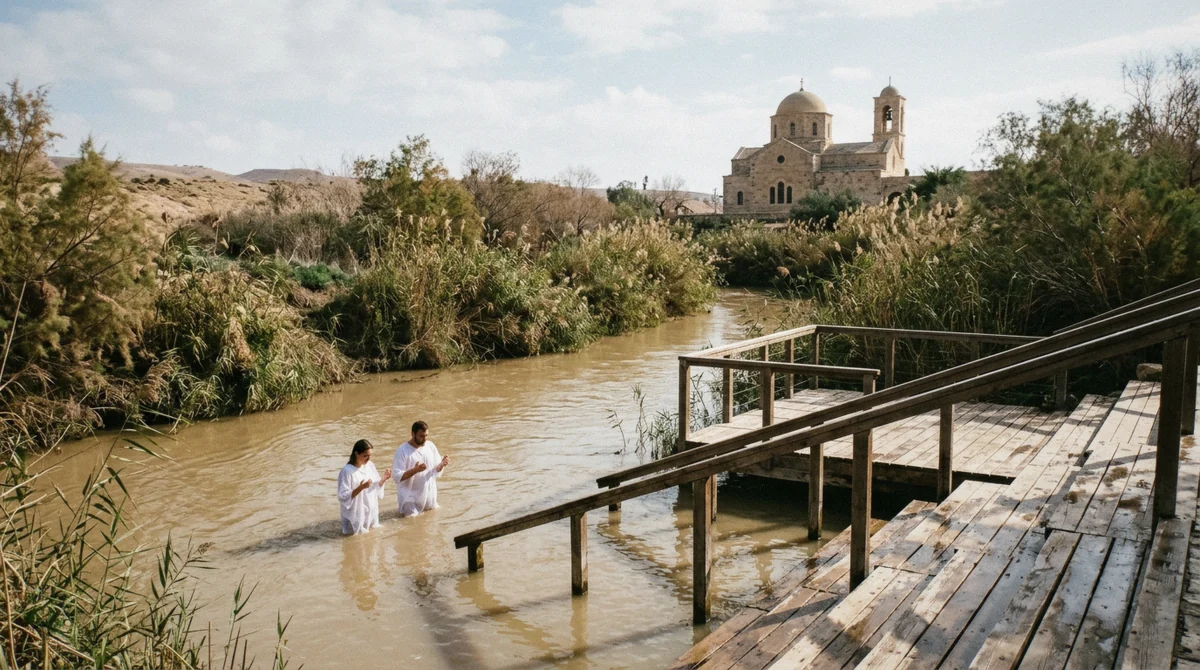
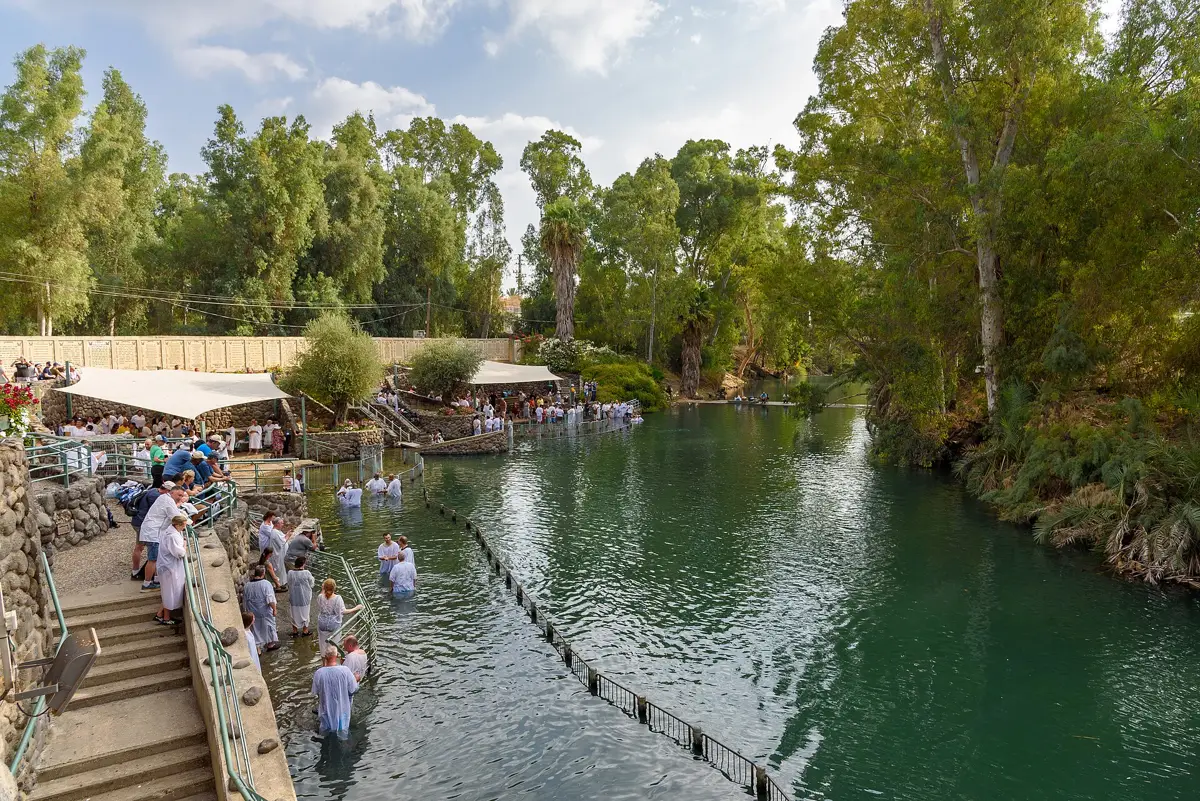
Illustrative image of pilgrims at the water at Qasr al-Yahud.
Quick answer What the baptism site is, which tours stop and how long each gives you
Qasr al-Yahud is the western section of the traditional baptism site of Jesus, in Area C of the West Bank and run by the Israeli Civil Administration and the Ministry of Tourism as a national park. You see the river itself, steps and handrails into the water, and a line of monastery buildings between the old structures and the bank called the Land of the Monasteries. Directly across the water stands Al-Maghtas in Jordan. The site was closed from 1967 during the Six-Day War and reopened in 2011. Two catalog trips stop here: the Bethlehem, Jericho and Jordan River day gives about 30 minutes and the West Bank tour gives 45 minutes.
Key takeaways
- Qasr al-Yahud is the traditional baptism site, with Al-Maghtas in Jordan visible across the river, on the Bethlehem, Jericho and Jordan River Day Tour from Jerusalem for about 30 minutes.
- The Best of the West Bank Tour from Jerusalem gives the longest visit in the catalog at 45 minutes.
- The name means the citadel of the Jews, after the nearby Greek Orthodox Monastery of St John the Baptist, which looks like a castle.
- This is not the same place as Yardenit in the Galilee, the baptism stop on the Nazareth and Sea of Galilee Tour from Jerusalem, see the comparison table below.
- Feast days draw the biggest crowds: January 6 for Epiphany, January 19 for Theophany and Easter weekend.
Which Trip Is Right for You
If you want the baptism site plus Bethlehem and Jericho in one day
The Bethlehem, Jericho and Jordan River Day Tour from Jerusalem covers all three, with about 30 minutes at the river, self-guided.
If you want the longest stop at the river itself
The Best of the West Bank Tour from Jerusalem gives 45 minutes at Qasr al-Yahud, plus Ramallah, Jericho and Bethlehem, and it is the only trip here with lunch included.
If you want a baptism site but have no interest in the West Bank
The Nazareth and Sea of Galilee Tour from Jerusalem stops at Yardenit in the Galilee for an hour instead.
If you are combining the river with the desert landscape
Pair a river stop with the Judean Desert Jeep Tour from Jerusalem: Mar Saba and the Desert Cliffs, which goes into the same desert region by 4x4.
If you want to understand the border logistics first
Read the guide on Jerusalem to Bethlehem for how documents and checkpoints work on West Bank trips.
What Qasr al-Yahud Is
Qasr al-Yahud is the western section of the traditional site of the baptism of Jesus by John the Baptist, a pilgrimage site since late antiquity. It sits in Area C of the West Bank, a little southeast of Jericho and about 15 km (9 mi) from the northern end of the Dead Sea. The Israeli Civil Administration and the Ministry of Tourism run it as part of a national park where baptism ceremonies can be performed.
The Arabic name translates as the citadel of the Jews. It refers to the nearby Greek Orthodox Monastery of St John the Baptist, whose fortified look gives the place its castle-like name. The site stands directly opposite Al-Maghtas on the Jordanian side, officially called Bethany Beyond the Jordan.
The river is narrow here, so the two countries' pilgrimage sites face each other.
What You Actually See
The draw is the water. Steps with handrails lead down into the Jordan, so pilgrims and visitors can enter or touch the river without climbing a bank. The river is narrow here, and the Jordanian bank are close enough to make out across it.
The Land of the Monasteries
Between the old monastery buildings and the river stand churches of many denominations, an area known as the Land of the Monasteries. They give the site its particular character: a strip of consecrated ground on both banks of a border river.
The view across to Jordan
Looking across the water you see Al-Maghtas, the Jordanian baptism site, officially Bethany Beyond the Jordan. You do not cross. The river is the boundary, and the visit stays on the western side.
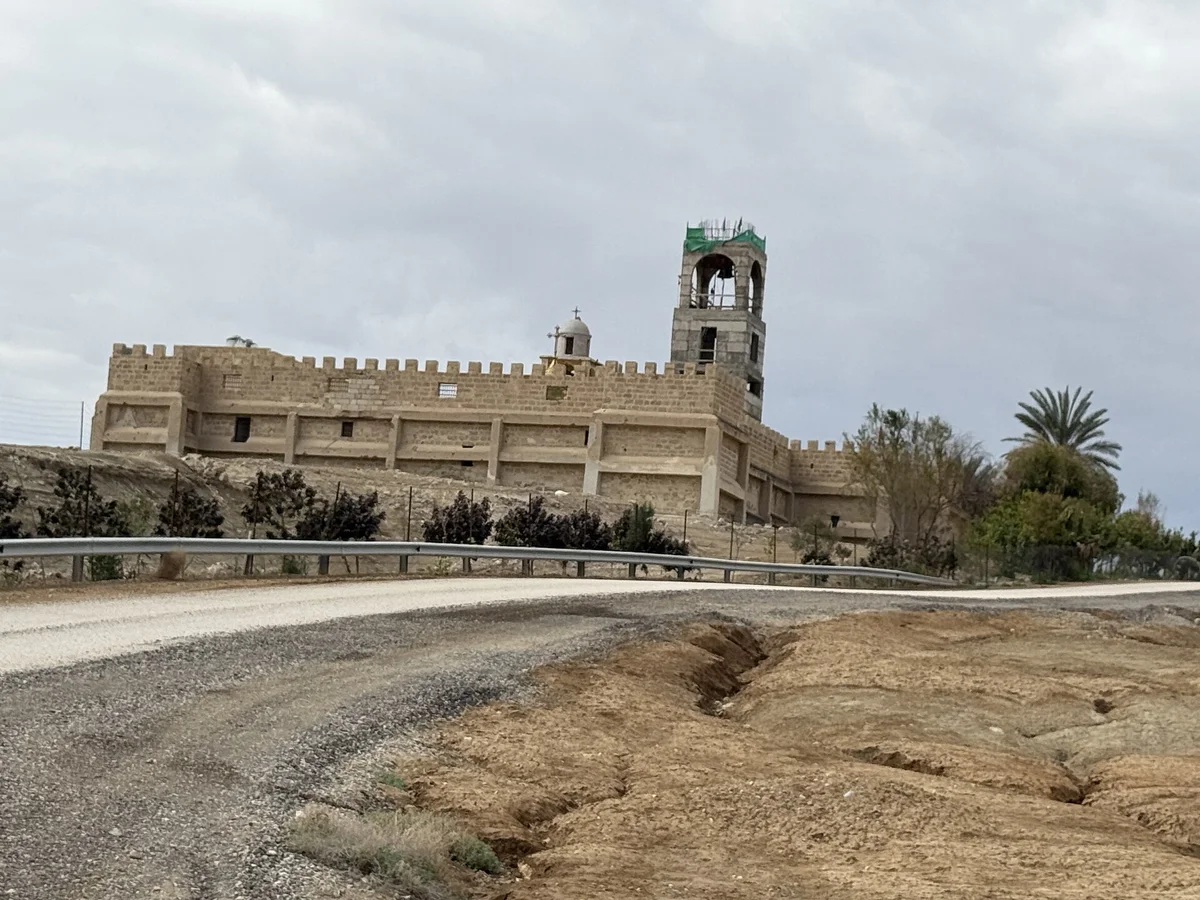
The castle-like Monastery of St John the Baptist, which gave Qasr al-Yahud its name. Photo: שלמה רודד, CC BY 2.5, via Wikimedia Commons.
The History: Closed in 1967, Reopened in 2011
The site sat in a front line. It was closed in 1967 during the Six-Day War. Pope John Paul II prayed here in 2000.
The restoration was approved before the millennium celebrations but delayed by the Second Intifada and by flooding in 2003. Since 2015 the site has been on UNESCO's tentative list of World Heritage Sites in Palestine, and the 1995 Interim Agreement gave Palestinians the right of pilgrimage to the baptism site under their own flag. The modern site reopened in 2011, laid out with the steps and handrails you see now.
The wider area carried a danger long after the wars ended: landmines near the monasteries. In 2019 the HALO Trust cleared landmines close to the site.
Justinian, the Templars and the Madaba Map
The site lies close to the ancient road and river ford that linked Jerusalem, by way of Jericho, with Madaba, Mount Nebo and the King's Highway on the far bank. The historian Procopius, writing around 560, says Emperor Justinian built a cistern here, and a description from 1883 still called it visible and almost perfect. Around 1172 the pilgrim Theoderic wrote that the Templars had built a castle next to the Greek monastery of St John to protect pilgrims on the way down to the river, though no trace of it has been found.
The 6th-century Madaba Map, the mosaic seen on the two-day Petra tour, marks Bethabara, the place of crossing, on the west bank of the Jordan. Archaeology from the same period points to the east bank, which is why Jordan and the West Bank each keep a baptism site facing the other.
Older Traditions: Elijah and the Crossing of the Jordan
Two stories from the Hebrew Bible are also placed here. Tradition holds that the Israelites crossed the Jordan into the Promised Land at this spot, which is one reading of the name Qasr al-Yahud. Tradition also places the point where the prophet Elijah rose to heaven on this stretch of the river.
That layered history is why the site matters to more than one faith. The same bend of the river carries a baptism tradition, a crossing tradition and a prophetic one, and the line of denominational churches along the bank reflects it.
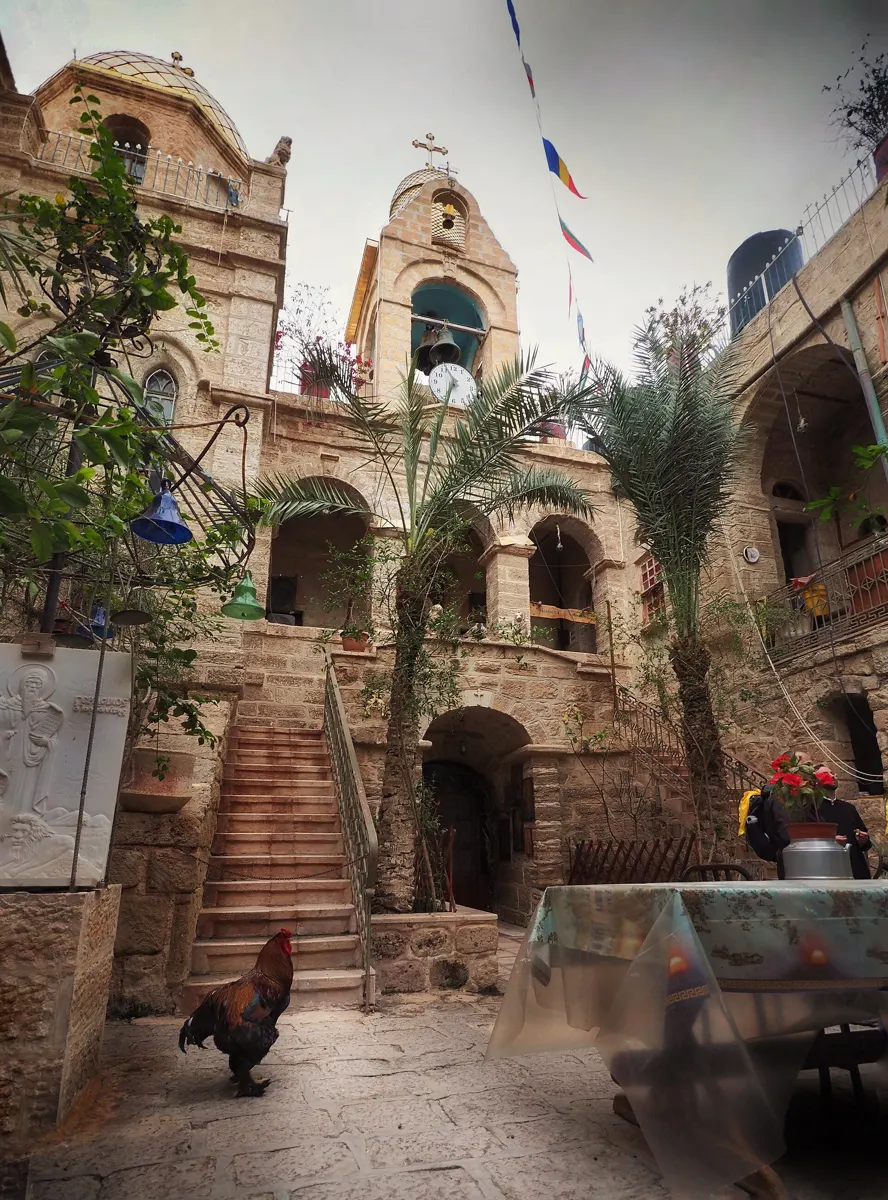
The St Gerasimos monastery at Deir Hijleh in the Jordan Valley. Photo: Ștefan Jurcă from Paris, France, CC BY 2.0, via Wikimedia Commons.
Feast Days and When the Site Is Busiest
Three windows draw the largest pilgrim crowds. Western churches mark Epiphany on January 6, Eastern Orthodox churches mark Theophany on January 19, and Easter weekend is the third. On these days the site fills with ceremonies and visitors far beyond a normal day.
- January 6: Epiphany, marked by Western churches
- January 19: Theophany, marked by Eastern Orthodox churches
- Easter weekend: the third major pilgrimage window
If you want quiet water, avoid those dates. If you want to see the site in its ceremonial role, they are the days to aim for, with the caveat that space and time at the river are much more constrained.
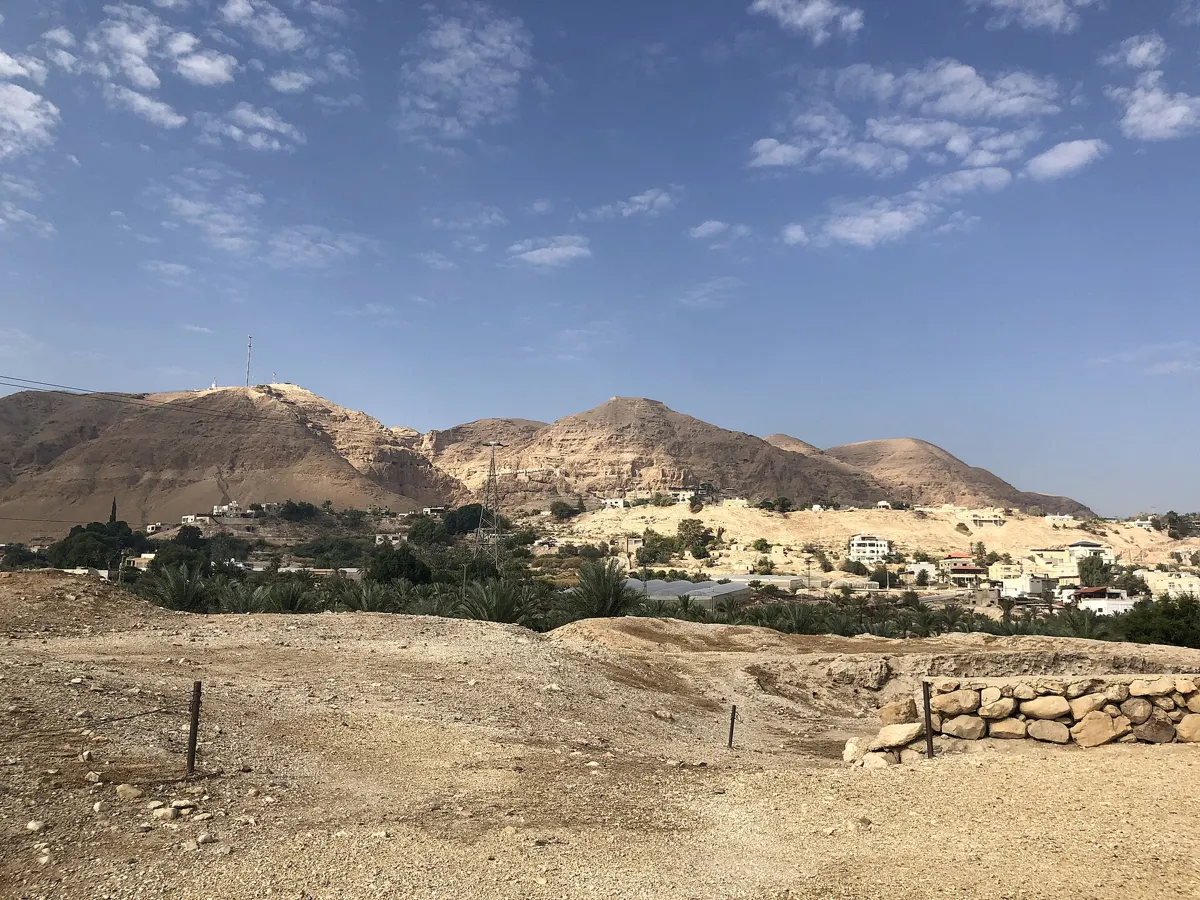
Jericho and the Mount of Temptation from Tell es-Sultan. Photo: Davide Mauro, CC BY-SA 4.0, via Wikimedia Commons.
Qasr al-Yahud vs Yardenit
Two baptism sites on the Jordan River are easy to mix up. The comparison below sets them side by side, using the site descriptions and the tour listings in this catalog.
| Detail | Qasr al-Yahud | Yardenit |
|---|---|---|
| Location | Jordan River near Jericho, in Area C of the West Bank, about 15 km (9 mi) from the northern Dead Sea | Jordan River just south of where it leaves the Sea of Galilee |
| Traditional link | The traditional site of the baptism of Jesus, plus the Israelite crossing and Elijah | A modern baptism site on the river, not the traditional baptism location |
| Who runs it | The Israeli Civil Administration and the Ministry of Tourism, as a national park | Kibbutz Kvutzat Kinneret |
| Across the river | Al-Maghtas in Jordan, Bethany Beyond the Jordan | No border here |
| Catalog trip | 45 minutes on the West Bank tour, 30 minutes self-guided on the Jericho day | 1 hour on the Nazareth and Sea of Galilee tour, stopping about 15:30-16:15 |
| Baptism with a priest | Baptism ceremonies can be performed at the national park | The Galilee tour does not arrange a baptism with a priest, travellers arrange that with the site |
The short version: if the traditional site and the Jordan border view matter to you, go to Qasr al-Yahud. If you are combining the river with a Galilee day, Yardenit is the stop. Read more in the guide on Jerusalem to Galilee.
Which Catalog Trips Stop Here
Some trips in this catalog stop at the Jordan River near Jericho, and one more stops at the Galilee baptism site. The table compares the visits, with the figures taken from the listings.
| Trip | Stop | Time at the river | Price per person |
|---|---|---|---|
| Bethlehem, Jericho and Jordan River Day Tour from Jerusalem | Jordan River baptism site, self-guided with the driver | 30 minutes | $150 |
| Best of the West Bank Tour from Jerusalem: Ramallah, Jericho and Bethlehem | Qasr al-Yahud | 45 minutes | $156 |
| Nazareth and Sea of Galilee Tour from Jerusalem | Yardenit in the Galilee | 1 hour | $108 |
Both river stops near Jericho are short. The Jericho day treats the river as one stop on a long three-city route, and the listing is clear that only Bethlehem is guided, so the river and Jericho are self-guided. The West Bank tour is the option if the river itself is a priority, since it budgets three quarters of an hour there.
For the full range of options by price and route, see Jerusalem day trips compared.
The Yardenit baptism site on the Jordan River in the Galilee. Photo: Mustang Joe, CC0, via Wikimedia Commons.
Documents and Practical Rules
Qasr al-Yahud sits in Area C of the West Bank, so the trips that reach it carry document rules. Both Jericho-area listings require a passport or ID card, and both state that Israeli passport holders cannot join. The West Bank tour asks specifically for the original passport.
On the Jericho day the vehicle changes at Bethlehem, where a licensed local Palestinian Christian guide takes over, and the listing calls the security checks entering and leaving Bethlehem routine. Bethlehem and Jericho are Palestinian cities in the West Bank, in areas administered by the Palestinian Authority. For more on how these visits work, see the guide asking is Bethlehem safe to visit.
FCDO advice places Jericho Municipality and all areas south of it, which includes the Allenby crossing, outside the areas it advises against in the West Bank, while advising against all but essential travel to the rest. Advice changes, so read the current FCDO page before you book and again before you travel.
What Else Is Nearby
The baptism site sits in the Jordan Valley, close to several major sites. Most visitors reach it as part of a wider desert day, and the table maps what pairs naturally with the river.
| Site | What it is | Distance note |
|---|---|---|
| Jericho | One of the oldest cities in the world, first settled about 11,000 years ago, called the city of palm trees in the Bible, about 258 m (846 ft) below sea level | A little northwest of the baptism site |
| Hisham's Palace | An Umayyad palace from the first half of the 8th century with a mosaic floor of nearly 850 square metres, entry $3.23 (10 NIS) on the Jericho tour | 3 km (2 mi) north of central Jericho |
| The Mount of Temptation | The mountain rising over Jericho, seen from below on the West Bank tour | Above Jericho |
| Deir Hijleh | The St Gerasimos monastery, a stop on the Bethlehem, Jericho and Jordan River day | Jordan Valley, on the route |
If you want more desert without the border formalities, the Judean Desert Jeep Tour from Jerusalem: Mar Saba and the Desert Cliffs runs a half day by 4x4 to a viewpoint above the Mar Saba monastery. For the wider region, see the guide on Jerusalem to Dead Sea.
What to Bring and Wear
The listings for the trips that stop at the river converge on the same short list. Bring your passport, since this is a West Bank route with checks. Wear comfortable shoes and modest clothing, and bring sun protection and cash for the sites that charge on the day.
- Original passport or ID card, as the listing requires
- Comfortable shoes for walking at each stop
- Hat and sunscreen
- Cash, since Hisham's Palace and Old Jericho charge $3.23 (10 NIS) each on the Jericho day
- A scarf or shawl for churches and monasteries on the route
- Water, one bottle per person is supplied on the Jericho day
If you plan to enter the water, pack anything you would want for that in advance, since neither stop is long enough for improvising. Modest dress matters at the churches along the route, and the listings rule out sleeveless tops, shorts and short skirts.
Getting to Qasr al-Yahud from Jerusalem
The simple way is a tour. From Jerusalem the site is reached by road through the Judean Desert past Jericho, The Jericho day starts at the David Citadel Hotel on King David St 7, and the West Bank tour meets at Ha-Nevi'im St 67. Both run about 10 hours door to door and return to Jerusalem in the late afternoon.
The two options differ in shape. The Bethlehem, Jericho and Jordan River day strings three major stops together, changing vehicles at Bethlehem, and gives 30 minutes at the river. The West Bank tour adds Ramallah, keeps groups to 20, includes an Arab-style lunch, and gives 45 minutes at Qasr al-Yahud, the longest visit in the catalog.
If your focus is the river, that extra quarter of an hour and the smaller group make the difference.
The drive itself is part of the experience: the road drops from the Jerusalem hills through the Judean Desert toward the Jordan Valley, one of the lowest places on Earth.
Questions and Answers
Can you visit the Jordan River where Jesus was baptized?
Yes. Qasr al-Yahud is the western section of the traditional site and is open to visitors as a national park, with steps and handrails into the water. It was closed from 1967 and reopened in 2011. The catalog tours stop for 30 to 45 minutes.
Was Jesus baptized in Jordan or Israel?
The traditional site straddles the river, which is the border. The western side is Qasr al-Yahud in the West Bank, the eastern side is Al-Maghtas in Jordan, officially Bethany Beyond the Jordan. Both claim the same event, and pilgrims visit both.
Is Qasr al-Yahud open to visitors?
Yes, the modern site reopened in 2011 and runs as a national park where baptism ceremonies can be performed. It sits in Area C, so bring a passport and expect the document rules of a West Bank visit.
What is the difference between Qasr al-Yahud and Yardenit?
Qasr al-Yahud is the traditional baptism site near Jericho, run by the Israeli Civil Administration and the Ministry of Tourism as a national park. Yardenit is a separate baptism site in the Galilee just south of the Sea of Galilee, owned and run by Kibbutz Kvutzat Kinneret, and is the stop on the Galilee day tour.
Can you get baptized at Qasr al-Yahud?
Yes. The site is run as a national park where baptism ceremonies can be performed. The catalog trips give 30 to 45 minutes at the river, so a private ceremony is a separate arrangement from a group day tour.
How do you get to Qasr al-Yahud from Jerusalem?
By road through the Judean Desert past Jericho, about a 10-hour round trip with site stops. The two catalog options are the Bethlehem, Jericho and Jordan River day tour and the West Bank tour, which both run from central Jerusalem and return in the late afternoon.